



Short answer
Use the exact in-game rules for the version in front of you. Examples on this page explain mechanics; they are not forecasts or betting advice.
The core idea
A random-number generator selects an outcome according to the tested game mathematics. The animation displays that result. A previous loss does not make the next spin more likely to win.
Worked example
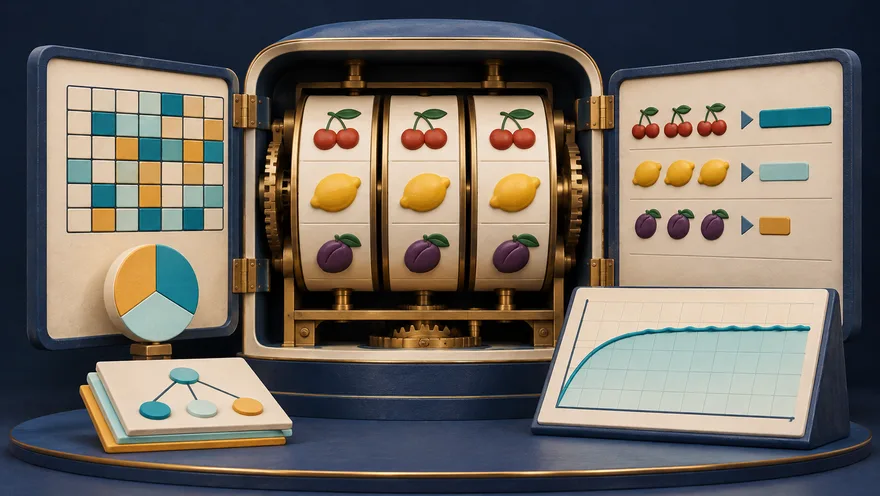
If a game uses paylines, the paytable states which symbols, positions and stake produce a prize. Ways-to-win and cluster games replace fixed lines with different matching rules. Cascades remove winning symbols and refill the grid, but each feature still follows the published rules.
What the number or rule cannot tell you
Fast features can make the cost per minute harder to notice. GB rules removed autoplay and require a minimum slot spin speed; the safer decision is still to choose a fixed session budget and watch total stake, not the number of apparent wins.
A pre-play reading routine
Open the rules before setting a stake. Record the RTP or house edge where stated, the payout rule, the volatility description, table limits and any feature that changes stake. Calculate planned turnover as stake multiplied by rounds. Treat the result as a budget check, not a target to win back.
Common misconception
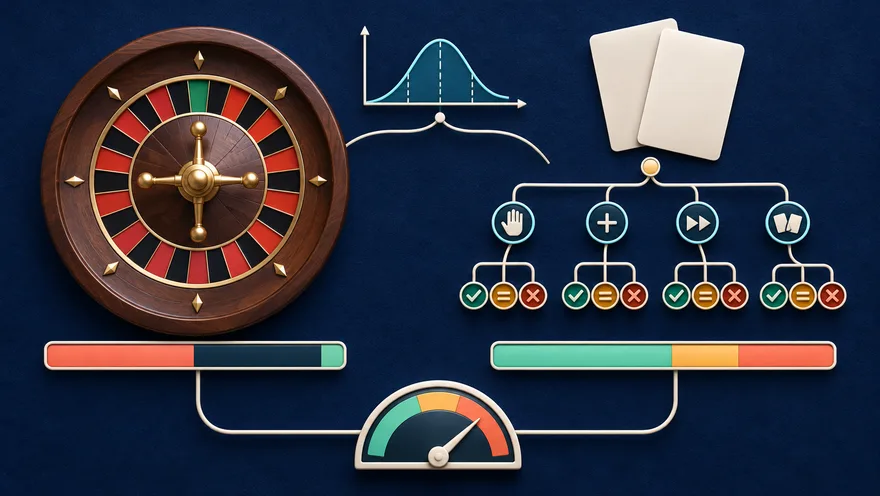
Short runs can sit far above or below a theoretical average. Random outcomes do not become more favourable because a player has lost, changed stake or watched a sequence. A clear rules page explains the mechanism without using “due”, “guaranteed” or “winning system”.
Safer stopping point
Set both a money limit and a time limit in advance. Stop when either is reached. If the urge is to increase stake to recover a loss, end the session rather than using a new mechanic or payment method.
Facts to record from the game
| Field | What it tells you | What it does not tell you |
|---|---|---|
| Rules/version | How this release resolves play | What the next outcome will be |
| RTP / house edge | Long-run design cost | Your session return |
| Volatility | Spread of possible outcomes | A safe stake or guaranteed duration |
| Stake and speed | Potential turnover per minute | A winning strategy |
Practical checklist
- Open the rules for the exact version.
- Record RTP or house edge and volatility where stated.
- Calculate stake × planned rounds.
- Set a money limit and a time limit.
- Stop rather than raising stakes after a loss.
Questions people ask
Can I predict the next outcome from previous results?
No. Random outcomes are not made due by a losing or winning streak.
Is the worked example a forecast?
No. It is an illustration of the published rule or long-run arithmetic.
Where should I verify a number?
Use the rules or help panel for the exact game version and a licensed operator’s information.
Continue the route
Sources checked 2026-11-18
- https://www.gamblingcommission.gov.uk/public-register/businesses
- https://www.gamblingcommission.gov.uk/public-and-players/guide/gambling-and-young-people
- https://www.gamblingcommission.gov.uk/public-and-players/guide/page/how-we-ensure-online-gambling-games-are-fair
- https://www.gamblingcommission.gov.uk/public-and-players/guide/return-to-player-how-much-gaming-machines-payout
Editorial note: Game rules, return figures and available versions can change. Check the exact in-game rules and paytable. Examples are illustrative and do not predict a result.