



Short answer
Use the exact in-game rules for the version in front of you. Examples on this page explain mechanics; they are not forecasts or betting advice.
The core idea
The game rules and random process should reflect the release being demonstrated, but a demo balance has no cash value. The useful test is whether you understand the controls and cost per spin, not whether the sample session “wins”.
Worked example
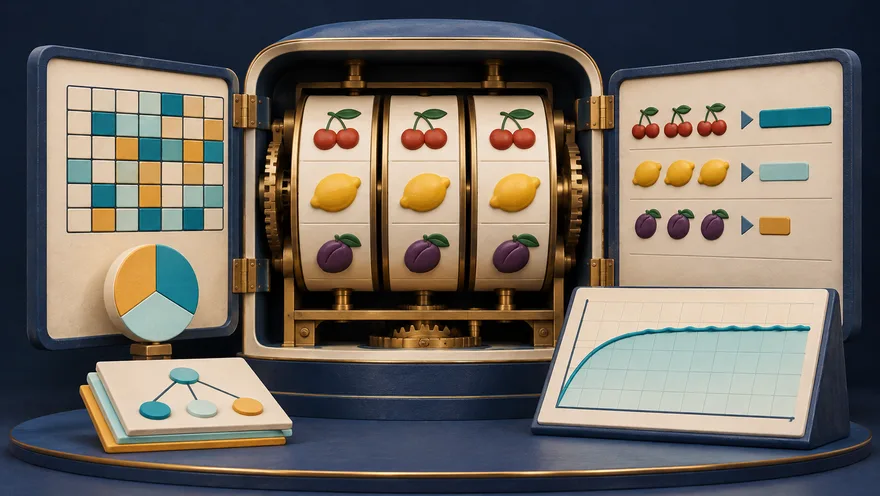
Use a demo to locate the RTP screen, check whether the game has fixed or adjustable paylines, see how cascades or bonus rounds work and calculate how many spins a planned budget buys at the selected stake.
What the number or rule cannot tell you
Do not treat a large demo win as evidence that the game is profitable. If a site exposes licensed-operator casino demos to unverified users in Great Britain, verify its relationship with the licensed operator rather than assuming the age rule does not apply.
A pre-play reading routine
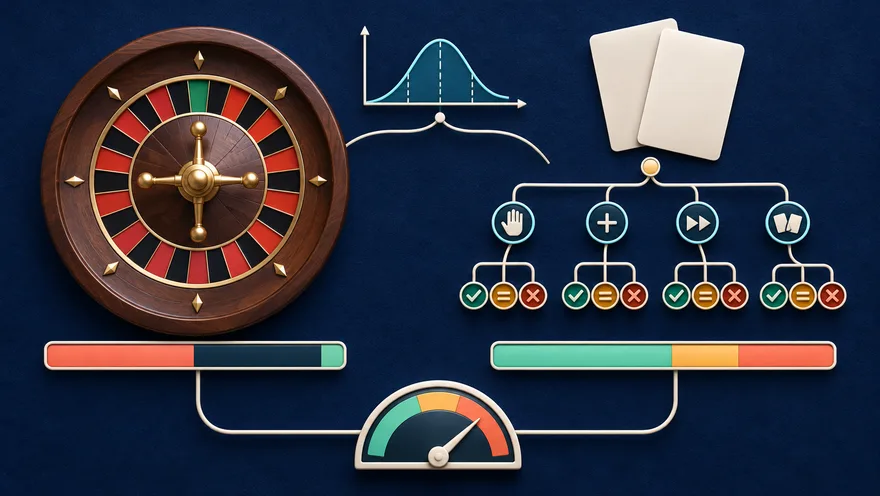
Open the rules before setting a stake. Record the RTP or house edge where stated, the payout rule, the volatility description, table limits and any feature that changes stake. Calculate planned turnover as stake multiplied by rounds. Treat the result as a budget check, not a target to win back.
Common misconception
Short runs can sit far above or below a theoretical average. Random outcomes do not become more favourable because a player has lost, changed stake or watched a sequence. A clear rules page explains the mechanism without using “due”, “guaranteed” or “winning system”.
Safer stopping point
Set both a money limit and a time limit in advance. Stop when either is reached. If the urge is to increase stake to recover a loss, end the session rather than using a new mechanic or payment method.
Facts to record from the game
| Field | What it tells you | What it does not tell you |
|---|---|---|
| Rules/version | How this release resolves play | What the next outcome will be |
| RTP / house edge | Long-run design cost | Your session return |
| Volatility | Spread of possible outcomes | A safe stake or guaranteed duration |
| Stake and speed | Potential turnover per minute | A winning strategy |
Practical checklist
- Open the rules for the exact version.
- Record RTP or house edge and volatility where stated.
- Calculate stake × planned rounds.
- Set a money limit and a time limit.
- Stop rather than raising stakes after a loss.
Questions people ask
Can I predict the next outcome from previous results?
No. Random outcomes are not made due by a losing or winning streak.
Is the worked example a forecast?
No. It is an illustration of the published rule or long-run arithmetic.
Where should I verify a number?
Use the rules or help panel for the exact game version and a licensed operator’s information.
Continue the route
Sources checked 2026-11-18
- https://www.gamblingcommission.gov.uk/public-register/businesses
- https://www.gamblingcommission.gov.uk/public-and-players/guide/gambling-and-young-people
- https://www.gamblingcommission.gov.uk/news/article/free-to-play-games-being-available-through-gambling-affiliates
- https://www.gamblingcommission.gov.uk/public-and-players/guide/page/how-we-ensure-online-gambling-games-are-fair
Editorial note: Game rules, return figures and available versions can change. Check the exact in-game rules and paytable. Examples are illustrative and do not predict a result.